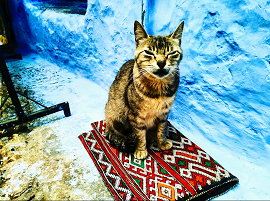
Morocco, this prodigious land in the north of the African continent, full of enchanted cities that seduce travelers with the vestige from the old times of warriors and princesses, and which invite you to get lost in theirs labyrinthine streets, where you enjoy with the five senses: the colors, the flavors, the smells, the textures and the noises. An unforgettable trip after which you will return home with another perspective about the world. I invite you to learn about them with me.
A WALK IN THE BLUE CITY OF CHEFCHAOUEN
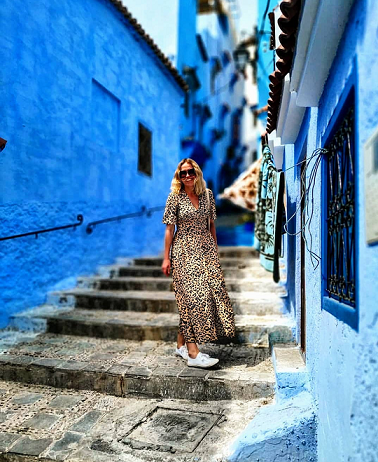
Chefchaouen, located in the north of Morocco and south from Tetouan, is worldwide known for its architectural constructions, which evoke the sky with their color and captivate the eyes of visitors. It was last year, when I had the opportunity to come by for the first time and observe this wonderful place with my friends.
An old legend tells that the city of Chefchaouen, whose Moroccan name refers to “horn” due to the shape of two mountain formations located near this city, was created in 1471 with all love of its founder, emir Moulay Ali ibn Rashid al-Alami to his beloved, an Andalusian lady, Lalla Zhora, who changed her Christian faith to Islam for emir’s love. Lalla Zhaora whose Christian name was Catalina Fernández, descended from a noble family, settled in Vejer de la Frontera, located in southern Spain, in Andalusia. If you ever have the possibility to visit both cities, you will discover the numerous architectural similarities that both locations exhibit. At that time the Iberian Peninsula was dominated by the latest victories of the Christian Kings, Isabel and Fernando, who occupied and conquered the last Muslim kingdom that resisted until 1492, the Emirate of Granada. The lovers, el emir Rashid al-Alami and his wife Lalla Zhaora, were forced to flee to North Africa, where they settled in a Berber population and where nowadays Chefchaouen is located.
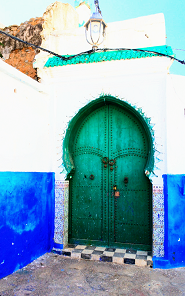
I recommend you when you arrive to Chefchaouen, a 40 thousand inhabitant’s city, to take a walk through the Medina, the Old Town area and enjoy its little corners, hidden among its alleys and squares. It is in the upper part of the Medina, where the houses are painted with the celestial color, hence the name of the Blue City. There are various craft shops, where the artisans offer handmade products as in the old times. I am sure that you will be fascinated by local items such as ceramics, carpets, scarves, argan oil cosmetics or perhaps djellaba, the traditional Berber tunic, baggy and hooded. But, you shouldn’t forget to haggle the price, although it is always important to offer a respectful amount. To end your tour in this fascinating Blue City, there is nothing better than a good Moroccan meal in a typical restaurant, such as Couscous, Tagine, Kefta and my favorite, the Pastilla, stuffed with almond paste and meat. Everything is so delicious!
TIPS:
- Take the main street in the Old Town to visit the whole Medina.
- Going to the main square Uta el-Hamman, you will find plenty of traditional shops.
- In Tangier or Tetuan you have the possibility to take a private taxi. It should be around 35E€. Remember to haggle.
- There are many Cannabis cultivation places around the city and you may be offered to buy so kief, but its consumption is completely illegal.
FES: HOW TO SURVIVE IN THE MEDINA WITHOUT GOING CRAZY
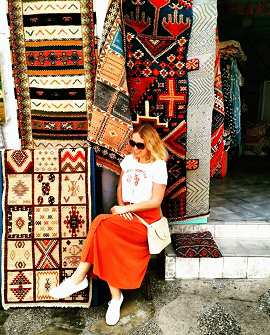
The city of Fes, the second largest in Morocco, located in the north part of the country, has an impressive Medina that confuses the visitors as you or me with its narrow alleys, full of traditional shops and crowds that come daily to shop or to visit this spectacular place. It makes you easily to get lost in the endless labyrinthine streets of the Old Town. A real madness that allows you to learn more authentically about the Moroccan culture. By the way, I supposed that you have already noticed that Muslim cities exhibit a very different urban plan from Roman-type cities, whose characteristics were exported to the New World. In fact, it is very easy to observe the evolution of the cities that firstly were conquered by Roman Empire (27BC – 476) and later by Muslims. The explanation of this difference is based on the cultural reasons. The Roman Empire maintained a significant administrative organization, planty of buildings were dedicated to the service for the State and were constructed around the forums, the squares from which the streets of regular layout, called cardo and documeno, began. While for the Muslim community, umma, religious matters were of primary interest, leaving the urban aspects in the backgrounds.
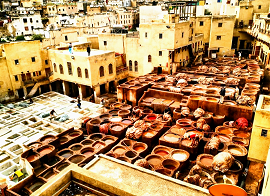
What is essential to do in Fes? I believe that the best way to have an exciting visit and to spend a good time is going to a place where the stench is so unbearable that it is necessary to carry a bouquet of peppermint so as not to pass out from so much disgust. I am completely serious. Have you heard of tanneries? They are traditional workshops in which the workers still follow ancestral techniques in order to produce the leather used to make bags, shoes, jackets or decoration elements. Their work consists in the following steps:
- The leather is immersed for several days in the lime liquid and pigeon droppings (hence so much stench).
- After that, the leather is taken into the bowls filled with natural dyes to obtain the different colors.
It is certainly an impressive sight for the visitors who enjoy the views from the terraces of adjoining buildings. I had the opportunity to visit one of the largest tanneries in Fes, the Chowara Tannery. In addition, apart of the show of traditional techniques of making leather, you also have a possibility to buy the craft products directly there.
TIPS:
- Medina in Fes is a labyrinth, it is not a bad idea to hire a guide in order to visit the place. You can really get lost there.
- If you don’t wish to hire a guide, you should take the Talaa Tabira street starting at the door Bab Bou Jeloud that crosses the whole Medina.
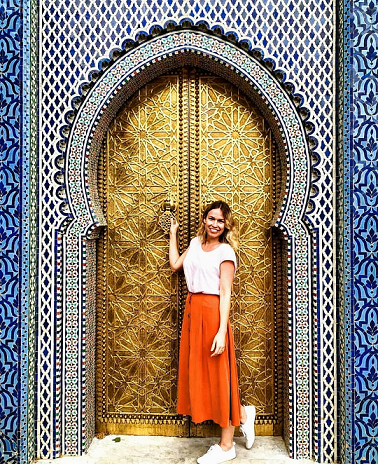
- You should visit al-Attarine Madrasa, a Koranic school, which exhibits a wonderful courtyard full of mosaic, and also take a picture at the bronze doors of Royal Palace.
THE MURALS IN ASILAH
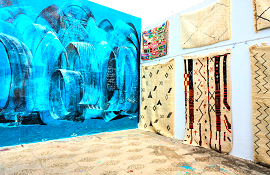
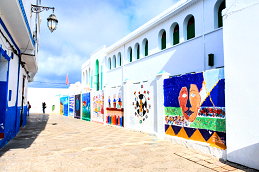
Asilah is a pearl located on the Atlantic coast, dating back to 1,500 BC, and it maintains the traces of the Phoenician era. Also, afterward the city was dominated by Carthaginians, the Romans, and in the medieval ages by the Umayyads, Almohads and Almoravids. Since the Portuguese conquest this part of Atlantic coast in 15th century, the city possess the defensive walls, built under the orders of Portuguese monarch, Alfonso V. Nowadays, this beautiful walls surround the Old Town that surprises the tourist with its uniqueness. Unlike Chefchaouen, the dominant color of the architectural constructions is white, which makes the city looks pure. Furthermore, the walls of traditional houses are decorated with colorful wall paintings or Andalusian designs. Inside the Old Town, it is possible to shop some handmade products, although the number of the stores is not as extensive as in larger cities and the street atmosphere is much calmer inviting you to take a relaxing walk.
TIPS:
- In my opinion Asilah is the best place to buy traditional products.
- It is only 50 km from Tangier. It is easy to get there by taxi or your own car. But, there is also a train from Tangier that costs around 2euros (2nd class) and it is a nice way to watch the Moroccan landscape.
- Outside the walls of the Old Town there are many delicious restaurant to have some lunch.
 all about eve`s journeys
2 thoughts on “THROUGH THE LABYRINTHS OF CAPTIVATING MOROCCAN CITIES”