Once upon a time there was a terrible event that marked the Spanish people forever, it is said that civil wars are always the most miserable since they sow hatred and a thirst for revenge among families and friends that last as a dark stain for years, and sometimes deeply ingrained are really difficult to disappear. The Spanish Civil War that took place between 1936 and 1939 was a turning point for the cheerful people from the Iberian Peninsula and has left an indelible mark, not only in the hearts of these people from southern Europe, so salutary and hospitable, but also feasible traces, in the form of destroyed villages, where the dreams of many families ended, or in strategic points of struggle, such as trenches, battlefields, etc., where brave young men fought for the defense of ideas that never saw come true. I would like to show you some of the places where these traces of the Civil War still remain, today in the form of monuments, which keep the memory of all the people who died in the terrifying event and so that future generations realize that war is not a solution, but a problem. It is necessary that we move to the autonomous community of Argon, located in the northeast of the country, where the bloodiest battles took place, of which there are still vestiges.
THE ORWELL ROUTE IN THE MONEGROS DESERT
For those of you who do not remember the History classes, the Spanish Civil War was a military conflict that began after a failed coup d`etat between July 17 and 18 in 1936. In Spain at that time there was the Second Republic, which began on April 14 in 1931, after the end of the monarchy of Alfonso XIII de Borbon on April 1 of the same year. By the way, since the proclamation of the Constitution of 1931, Spanish women obtained the right to vote for the first time in the history, a great achievement for them! The situation was not easy for the Government of the Republic, not only due to the fact that there were economic shortcomings that made it impossible to carry out numerous political proposals that could modernize the country, but also there was a strong opposition from conservatives, whose main objective was to preserve the way of doing things according to customs and they did not see with a good eye the novelties introduced by the Government. To make matters worse, the Government of the Republic itself, made up of different political groups, was not an ideal place for negotiations either, since all parties pretended to impose their point of view and it was difficult for them to give in. In this way, the truth is that the Republic had it very difficult to advance…
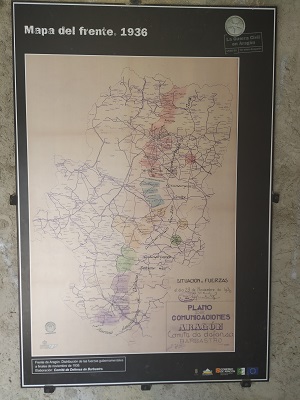
“It is curious that after the experiences I have lived I have not less but more faith in the honesty of human beings” had said George Orwell after returning home. This famous writer, like also Ernst Hemingway, participated in the Civil War supporting the republican side. Orwell was assigned to the Sierra de Alcubierre, a superb place, where according to his words the fascists who were only 400 meters located from them, hardly bothered to fire their rifles, but “they sent relentless bursts of machine guns towards anyone who looked out”. The trenches, in which Orwell spent a lot of time, a type of military engineering, used already during the First World War (1914-1918), were the place where the military stayed for months, usually in terrible and unsanitary conditions, which made them even more unhappy and miserable. In the Monegros Desert there are still vestiges of some of them that can now be visited. In military terminology this type of construction is called fortification, its objective is to favor the defense, making the offensive difficult, reducing the number of casualties and forcing the enemy to concentrate their forces in a small and close space.
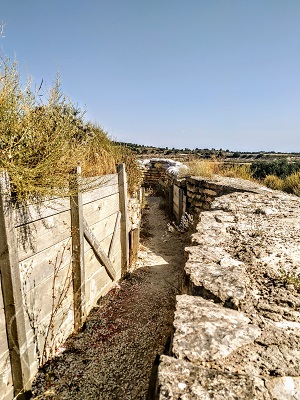
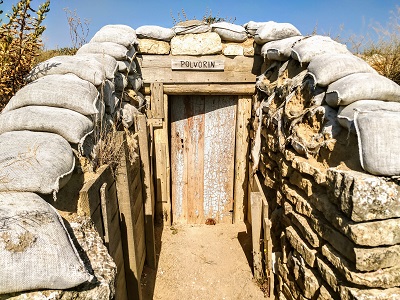
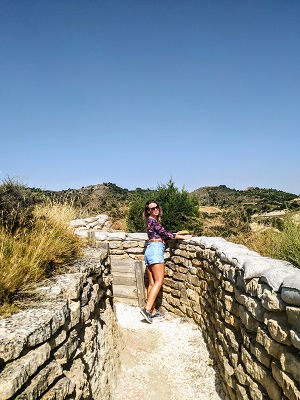
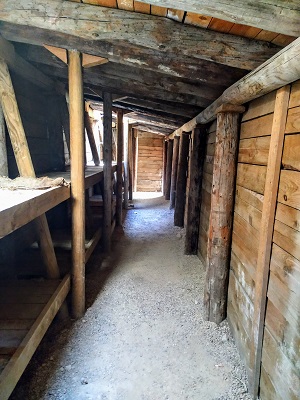
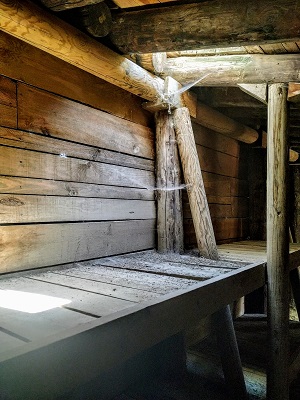
Some of the most important part of the trenches are:
- Communication branches: these are corridors that allow easy movement among the various strategic points, without the need to expose the soldiers to enemy fire. They are usually built in a zigzag or undulating manner and adapt to the orography of the terrain. Its depth ranges between 0.70 and 1.70 meters.
- Bivouac: the living area, used by soldiers to rest, cook or write letters to their families and their memories.
BELCHITE: THE GHOST TOWN
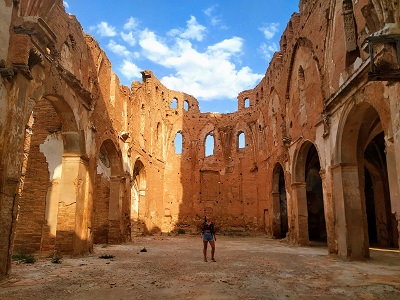
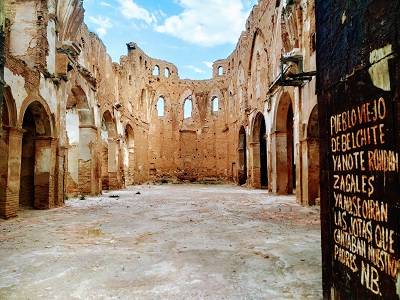
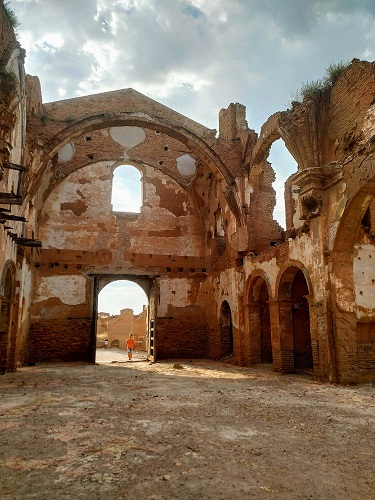
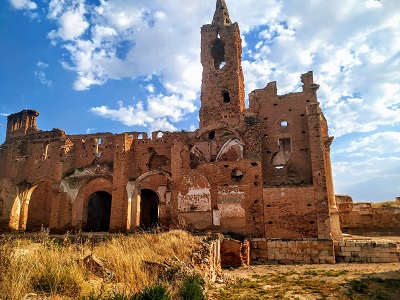
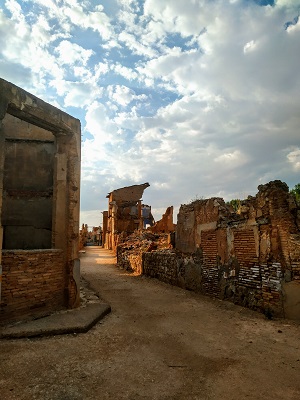
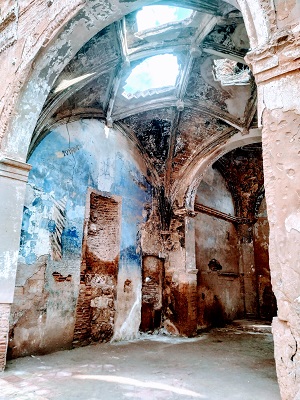
Belchite, a town near Zaragoza, just 50 km away, suffered the direct consequences of the Civil War on several occasions. In this small town there were up to two bloody battles that ended its existence as such, turning it into the ruins that today you have the opportunity to visit through a guided tour. The first battle took place at the end of August 1937 and ended with more than 5000 people killed and buried hastily in a mass grave, in order to prevent the decomposition of the bodies under the hot August sun, in addition there were more than 3000 prisoners. While the second battle occurred just half a year later, in March 1938. In both cases, the victory was not strategic, but rather symbolic. Later, General Franco, after changing his mind decided to keep the ruins instead of rebuilding the town, using them for propaganda purposes, the main objective of which was to criticize the devastating passage of Marxism through the Iberian Peninsula. In this way, Belchite was never rebuilt, although next to it a new town arose thanks to the slave labor of the prisoners of war who lived in a nearby camp, called “the Little Russia”. As you walk among the collapsed and lonely houses, enter in the main parish of the town, the Church of San Martín de Tours, and appreciate its greatness despite being in ruins, feelings of disappointment will be created within you, so much beauty and horror in the same place.
TIPS:
- Check the timetable and book in advance your visit, the entrance is not free.
- On the contrary, the trenches in the Monegros Desert are free and you can visit them anytime, they are well maintained. You should look for The Orwell Route, the place where the writer spent a long time.
- During the summer days it is really hot in the desert, bring some water with you.
 all about eve`s journeys
One thought on “THE VESTIGES OF THE SPANISH CIVIL WAR IN ARAGON”