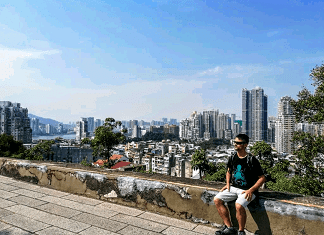
In my previous article about Hong Kong, I told you about this magnificent city and I mentioned that if you ever have the opportunity to visit it, you should not forget to spend few days visiting Macau, a former Portuguese colony and the current Special Administrative Region of China that enjoys some autonomy. The distance between both cities is only 70km and thanks to the modern infrastructure network there are many possibilities to travel between them. I am sure that you are going to love Macau.
WHAT HAPPEND WITH MACAU?
The city of Macau belonged to Portugal since 1556, although for several decades it also passed through the hands of the Spanish Empire. It always held a privileged position by becoming the gateway for missionaries heading to China. And the presence, above all, of the religious order of the Jesuits, founded in 1539 in Rome by the Spaniard Ignacio de Loyola, promoted educational development among the city’s inhabitants. During the 20th century there were many migrations to Macau, due to the conflict of World War II. Unlike Hong Kong, it was not occupied by the Japanese since Portugal maintained neutrality during the war. On the other hand, later, during the proclamation of the People’s Republic of China, the city welcomed the supporters of Kuomintang, the Chinese nationalist party, founded in 1911, whose current headquarters are in Taipei. Finally, it was on January 1, 2000, when China was able to regain the Macau administration.
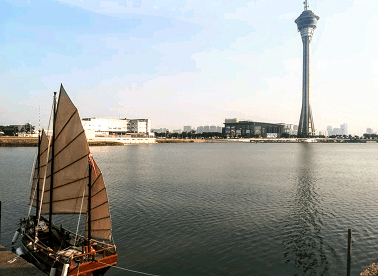
VISITING MACAU
What has surprised me the most about Macau is the fact that so far from Europe still today architectural structures that remind of typical Portuguese buildings are preserved in it or that in the main street of the old town the vendors invite you to try some cream cakes that you have the possibility to taste whenever you visit Lisbon. However, at the same time among these typical candy stores that are a reflection of the colonial past, you find the manga comic shops so typical of Chinese popular culture. It is fascinating how this city represents the perfect fusion between the Asian spirit, the colonial past and modernity.
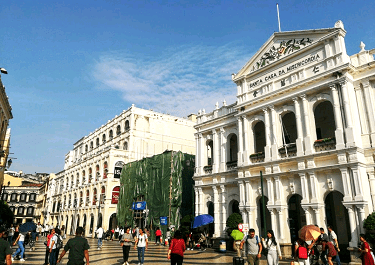
Once you arrive in Macau after an hour’s journey on the boat of the Turbo Jet or Cotai companies, on your way to the historic area you will come across numerous Portuguese vestiges, such as the names of some casinos or streets, etc. Senado Square will completely surprise you, since it is the central part of the old town that could easily be mistaken for a European city. I, of course, was speechless. I don’t mean to say that Chinese constructions are of lesser value, not at all, it is a very interesting art, and however, contemplating the typical buildings of the most European style in this part of the world was truly amazing for me. By the way, near the Senado Square, the Rua de la Felicidade is located, where different scenes from the movie about Indiana Jones adventures were shot (in my other article about Petra I also talk about places with the scenes from this movie).
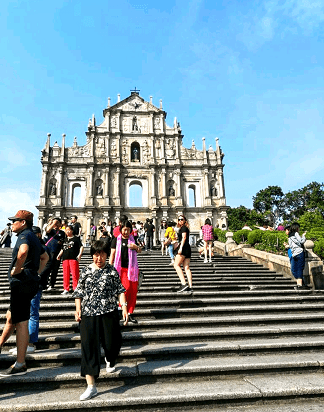
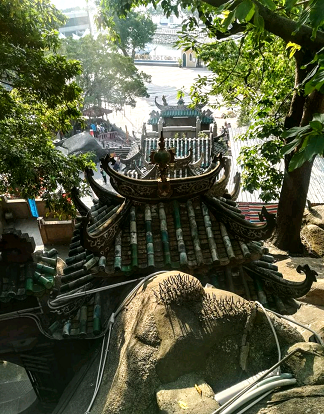
One of the very interesting tourist attractions of the Chinese city, are the Ruins of San Pablo, of the old Church of the Mother of God that was destroyed with the fire of 1835. The magnificent façade that is reached by means of a staircase is still kept in perfect condition. If you like a bit of hiking, I also recommend you go up to the Mount Fortress built in the 17th century from which you will have the opportunity to contemplate the entire city and its most emblematic buildings. It is a garden area, where you can take a relaxing walk while contemplating the beautiful views of the city. To rest a bit from the sightseeing, don’t forget to stop at the Venice of Macau, a commercial center, full of restaurants and cafes, which resembles the Italian style.
TIPS:
- If you are coming to Macau from Hong Kong, the best way is by boat. The journey is around 1 hour.
- Remember that Macau is a kind of Chinese Las Vegas so visit one of its casinos. Maybe you will even be lucky and earn some money… Who knows?
- Try the cream cakes, made with the traditional Portuguese style, and feel the colonial past of the city through its flavors.
 all about eve`s journeys